How to play
- Tap or drag cards to the legal destinations indicated on the screen.
- Use open spaces to expose the cards needed for the current layout.
- Follow the stage objective and in-game prompts as you clear the board.
How to play
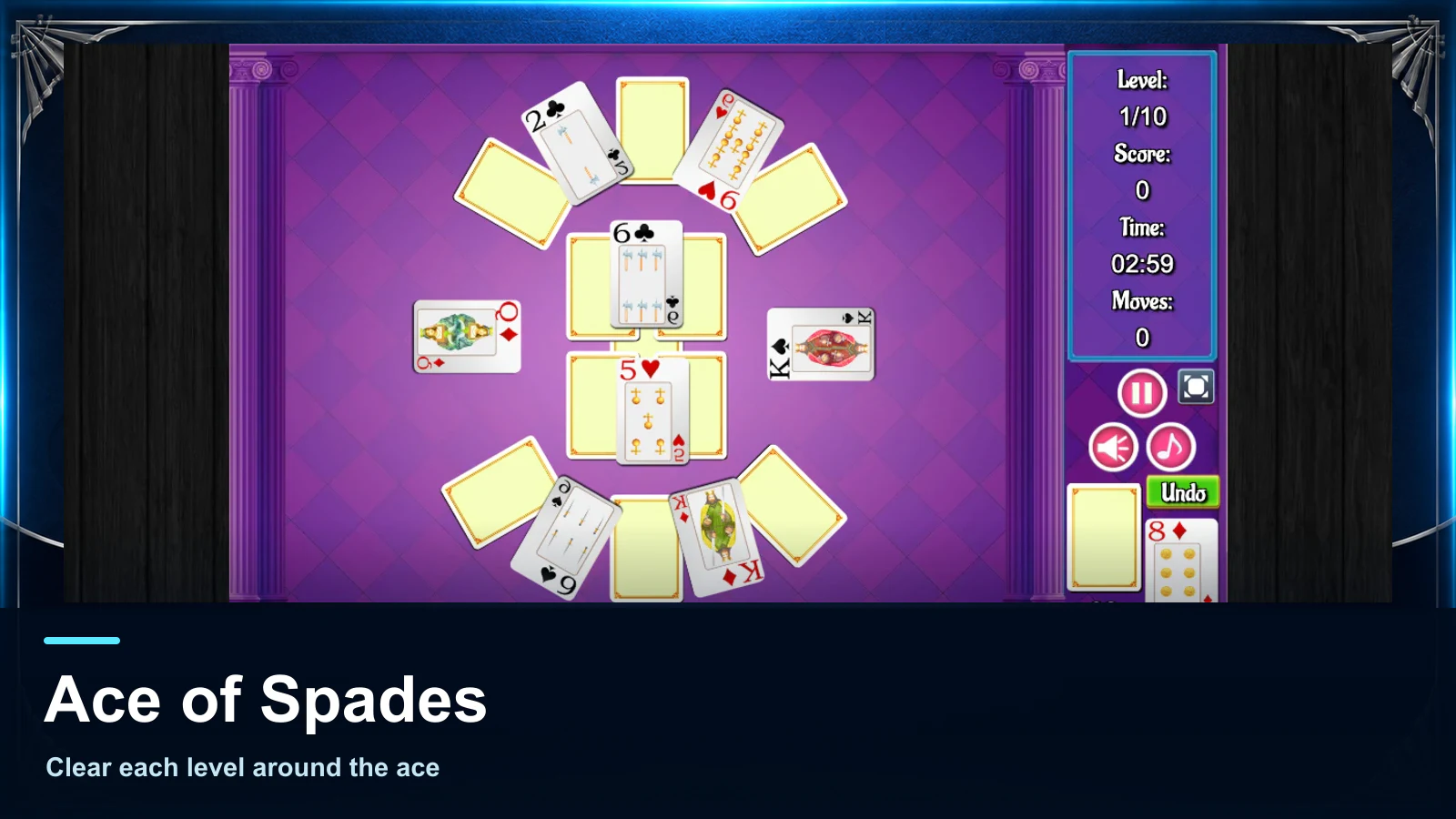
Ace of Spades Solitaire is a stylish level-based card puzzle with the Ace of Spades at the heart of its presentation. Each layout asks you to read the available cards, notice the places that can receive them, and choose an order that opens the board rather than merely rearranging it. The pleasure comes from a sequence of small discoveries: one move reveals a card, that card creates a destination, and the next route begins to appear.
When a stage starts, look at the movable cards, open spaces, and the cards that would be revealed by each transfer. Read the objective and on-screen guidance, then compare the available options. The first legal move is not always the best move. A stronger choice usually exposes information, uncovers a low card, or creates a useful receiving position for another card.
Before moving a card, check both ends of the transfer. What will become visible where the card leaves? What new card can be placed where it arrives? If the answer produces a follow-up move, the transfer is doing real work. If it only changes the appearance of the table, keep looking. This simple comparison turns a busy layout into a set of clear, practical decisions.
An empty area is valuable because it supports the next rearrangement. Do not fill it automatically. First decide whether the space can temporarily hold a blocker, reveal a card underneath, or help another column accept a needed rank. A card placed without a purpose can consume the exact working room that a later sequence needs. Protecting open space is often the difference between a smooth solution and a stalled board.
The best turns usually connect two or three moves. A card shifts, a new card appears, and that card immediately has a legal home or reveals another route. Look for these chains rather than isolated moves. If the game seems stuck, reconsider the last transfer and test an alternate order. Moving a different blocker first can turn a closed-looking area into the opening for the entire stage.
The layouts change from stage to stage, but the planning habits stay useful. Pause at the start, identify useful low cards and receivers, preserve working space, and favor moves that create another option. A failed attempt is still useful feedback: it often reveals which card was moved before it had a purpose. With that observation, the next try becomes more deliberate and more satisfying.
This game suits players looking for a relaxed card puzzle that is more visual and stage-driven than Classic Solitaire. It is easy to begin because the game shows valid directions, while its layouts still reward careful attention and a willingness to plan one move ahead.
When two moves are legal, choose the one that leaves the board with more distinct destinations. A card route is safer when its next landing place remains visible after your transfer.
No. Prefer a legal move that reveals a card, creates a receiver, or begins a clear follow-up sequence.
Review the last move and try a different order that preserves an open working space.
Loading comments...