How to play
- Tap or drag cards onto the next higher rank of the same suit.
- Store one card in each of the four free cells when needed.
- Build four suit foundations from Ace to King.
How to play
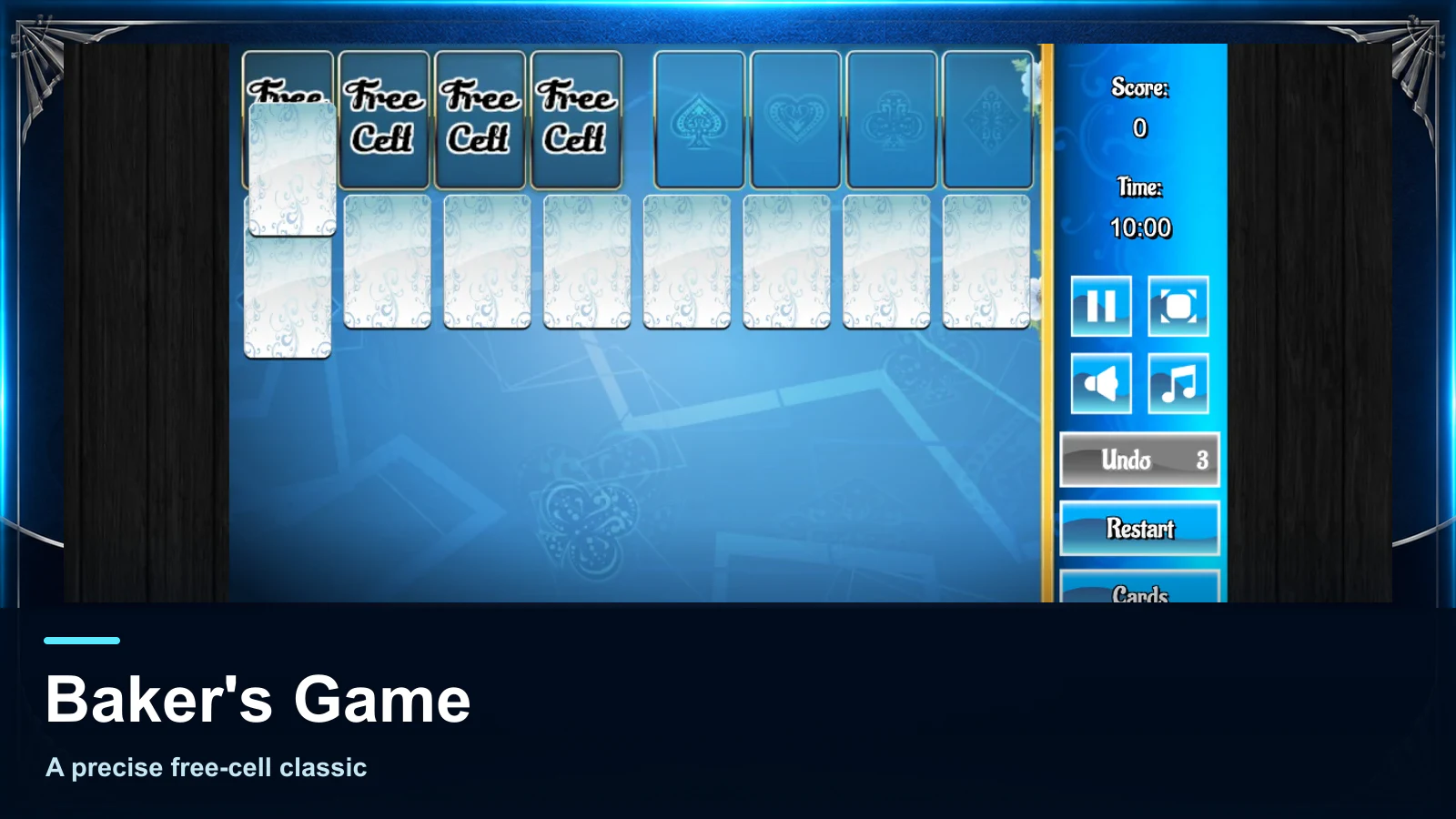
Baker's Game Solitaire is a thoughtful, visible-information card game in the FreeCell family. The tableau builds down by the same suit, and four free cells provide temporary storage while you uncover routes to the foundations. Because so much of the layout is visible from the start, the satisfying part is not guessing what comes next. It is deciding which column should be opened first and which card must remain available as a receiver.
Move all cards to four foundations, building each suit upward from Ace through King. In the tableau, a card can rest only on the next higher rank of its own suit. That restriction makes every destination meaningful. A move that looks legal may still be poor if it removes the only place where another card can land. Good play balances foundation progress, open tableau routes, and free-cell capacity at the same time.
Before the first move, look for Aces and 2s, then scan for short suited links that can become useful quickly. Also compare what each candidate move exposes. Moving a club 7 is more valuable when it reveals an Ace or creates a receiver for a club 6 than when it merely makes one column look tidy. The board gives you information, so use it to make a small plan rather than reacting to the first available move.
A free cell is a powerful parking space, but all four filled cells can make the game rigid. Before placing a card there, identify the return route: perhaps it will expose a low card, allow a suited link, or free a second temporary space. If the next step is unclear, leaving a cell empty is often stronger. One open cell can turn a blocked sequence into a reversible maneuver when a new card becomes available.
Same-suit building means a heart 8 needs a heart 9, not simply any black 9. It can be worth moving a blocker into a free cell to join two cards of one suit, but length alone is not the target. Ask what the route releases. A short spade connection that lets you reach a foundation-ready card is more valuable than a longer run that leaves every important low rank buried.
Foundation moves shrink the tableau, yet a foundation-ready card can still be an important receiver. If a 6 is the only available home for a visible 5, sending that 6 away may stop a useful transfer. Prefer foundation moves that reveal a card, free a cell, or complete a planned route. When a move only improves the foundation total without changing the board, pause and check whether the card has another job first.
In the opening, release low ranks and preserve free-cell capacity. In the middle, create suited links that uncover blocked columns. Near the end, inspect the next required rank on each foundation and work backward through the cards above it. Baker's Game rewards the same measured thinking as FreeCell, while its same-suit rule gives every small rearrangement a sharper purpose.
No. Tableau cards build downward in the same suit.
Use it for a temporary move with a clear follow-up that exposes a card or creates a suited destination.
Loading comments...