How to play
- Tap or drag cards to the legal destinations shown on the table.
- Use free cells as temporary working space for a planned rearrangement.
- Follow the in-game prompts to complete card runs and clear the layout.
How to play
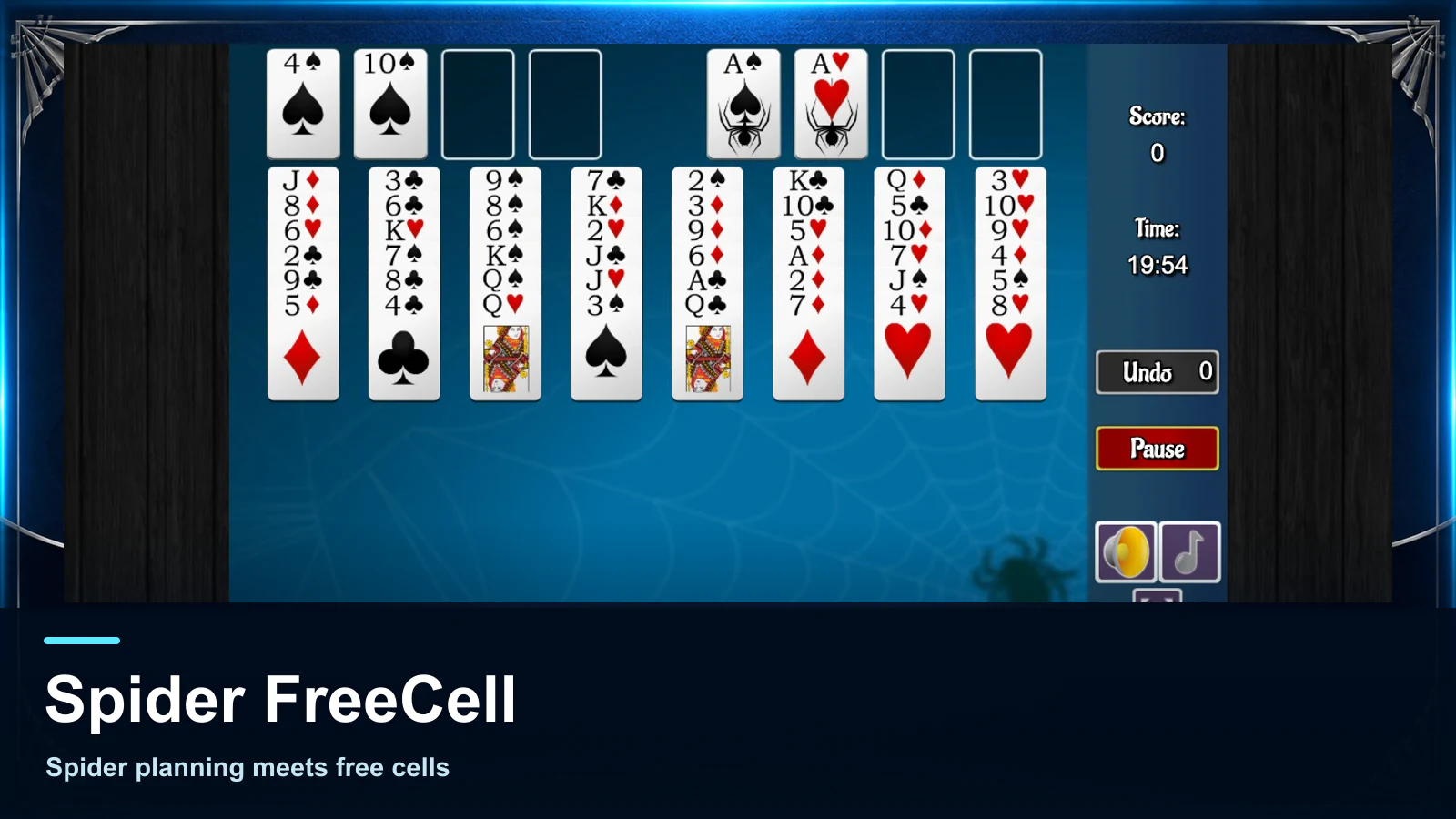
Spider FreeCell Solitaire combines the satisfying sequence-building pressure of spider-style games with the breathing room of temporary free cells. The board rewards players who notice relationships between several columns instead of chasing the first legal move. A small transfer can reveal a card, create a receiver, or make an entire run easier to manage, so the best turns often begin with a quick look across the whole layout.
At the opening, compare available moves by what they change after the card lands. A move that creates a long sequence is not always the best one. Moving a card away from a column top can be stronger if it reveals a useful card or makes a new destination available elsewhere. Check the source column, the destination column, and the free-cell area before committing to a transfer.
Free cells are not simply places to hide inconvenient cards. They are working space for a specific rearrangement. Park a card when that removal reveals a lower rank, lets two useful cards connect, or opens a receiving space in another column. Filling every cell too early reduces the board to a set of fixed piles. Whenever possible, retain one open cell so that an unexpected opportunity can become a real move.
It feels good to make an ordered run, but a sequence is valuable because it changes what can be moved next. A short run that frees a blocked card can be better than a beautiful long run that leaves the rest of the board unchanged. Look for a card that will become available after the move, then decide which connection makes that card usable. This turns the layout into a series of manageable local puzzles.
Low cards can reduce clutter and open room, but do not advance them automatically if they still serve as a needed tableau receiver. Before moving a card away, ask whether another visible card needs that exact landing place. Make the move when it exposes a card, frees temporary storage, or clearly continues your plan. The goal is not merely to make a score rise; it is to leave the board more flexible.
When moves seem scarce, stop focusing on the longest column. Instead, look for a move that empties one free cell or changes the top card of a blocked stack. One small pocket of space can make a second and third rearrangement possible. If the game offers Undo, reverse the last decorative-looking move and test whether moving a different blocker first creates a cleaner route.
This variation suits players who enjoy the card-run puzzle of Spider Solitaire but also like having a limited planning buffer. It rewards calm sequencing rather than speed. Each round becomes clearer when you measure a move by the options it creates for the next two turns.
Before spending the last free cell, name the card that will become available and its likely next home. If neither is visible, preserve the space and examine another column first.
No. Keeping a cell available usually preserves more useful choices.
A productive move reveals a card, creates a receiver, or gives a blocked sequence a clear next step.
Loading comments...