How to play
- Tap or drag a card onto the next higher tableau rank.
- Build each foundation upward in suit from Ace to King.
- Use empty columns to stage a specific rearrangement; Kings stay fixed.
How to play
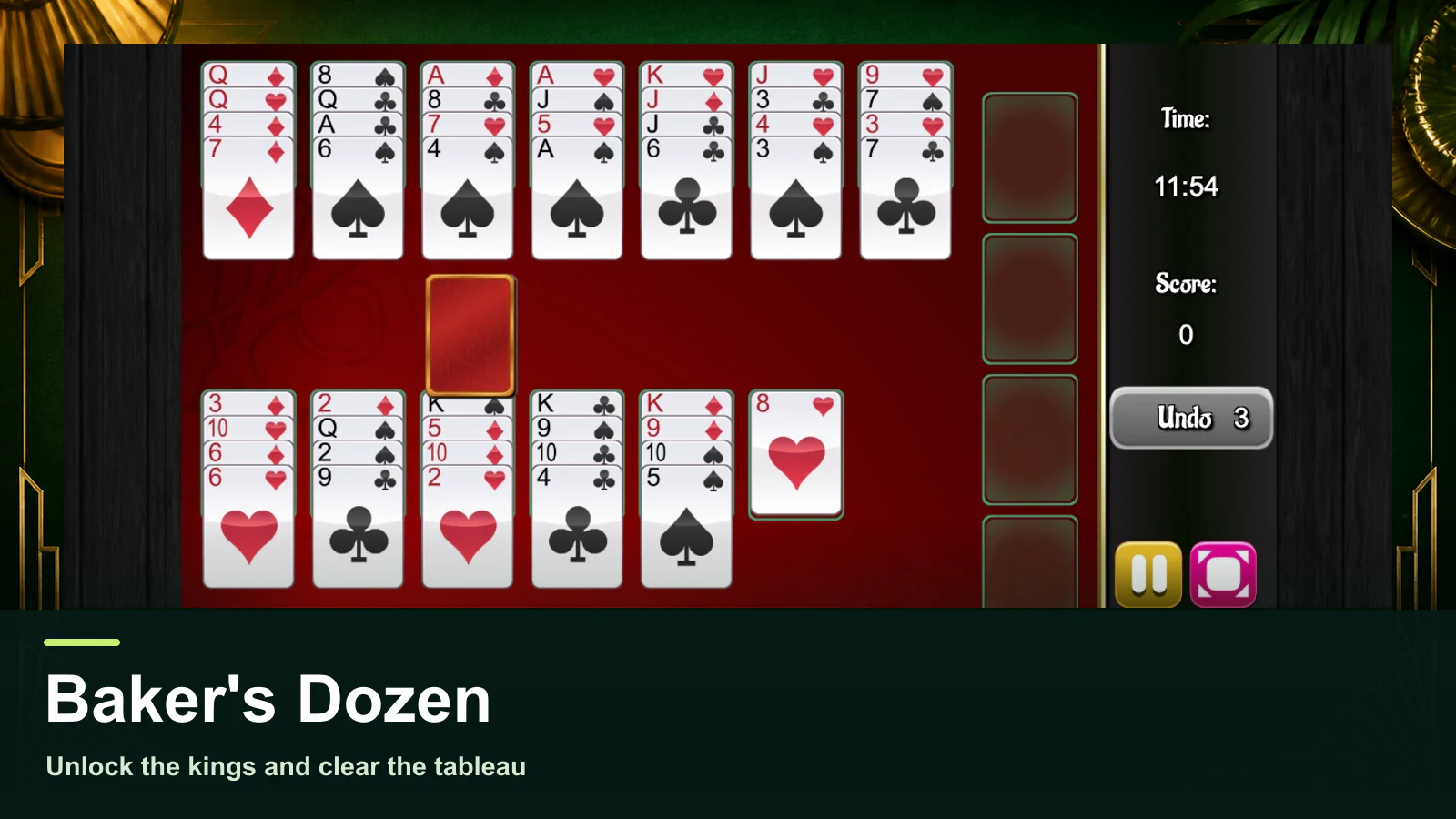
Baker's Dozen Solitaire is a twelve-column game built around a rule that changes the usual solitaire rhythm: Kings cannot move in the tableau. You still build four suit foundations from Ace to King, and you can place a card onto the next higher rank regardless of suit or color. But every King acts like a fixed base. To reach the cards below it, you must patiently clear the cards stacked above it.
Your goal is to move every card to the four foundations in suit from Ace through King. The tableau begins with all cards visible, so the puzzle is not about guessing what is face-down. It is about reading the order in which columns can be shortened. A legal move is useful when it exposes a foundation card, opens a route above a King, or creates a dependable landing place for the next card.
Start by comparing the columns that contain Kings. A King with only two cards above it may become productive quickly; a King buried under a tall column can define the whole middle game. Look especially for low cards directly above a King. If moving a 3 reveals a 2 that can immediately feed a foundation, that column has more practical value than a longer sequence that does not reveal a usable rank.
It is tempting to merge every possible descending pair, but doing so can hide the card you need to free a King. Before stacking a card, ask whether its former column is closer to opening a route. In this game, a tidy tableau is not automatically a flexible tableau.
An empty tableau space can hold a movable card of any rank, which makes it powerful temporary storage. Do not fill it just because a card fits. First name the result you want: perhaps moving a 9 aside will free a foundation-ready 8, or perhaps it will let a 10 receive a card from another blocked column. If you cannot describe the follow-up move, keep the space free. It may be more valuable one turn later.
Foundation moves are usually good because they reduce the tableau, but a card can also be an essential receiver. Suppose a 7 can go to a foundation but several 6s need somewhere to land. Moving it immediately may leave a blocked 6 with no destination. Check the visible ranks around a foundation candidate. If the move reveals a card or frees a King route, take it; if it only makes the foundation look fuller, consider holding it briefly.
Early game: release Aces, 2s, and 3s while reducing the shortest King columns. Middle game: preserve enough middle-rank receivers to transfer cards between columns. End game: trace each remaining foundation rank back to its current column and remove the cards above it in reverse order. This deliberate approach makes Baker's Dozen a satisfying choice for players who enjoy the visible-information planning of FreeCell with a stricter board shape.
No. The fixed Kings are the defining rule, so plan to clear cards above them rather than relocate them.
It lets you temporarily separate a blocked sequence. Save it for a move that reveals a card or creates a needed receiver.
Loading comments...