Controls
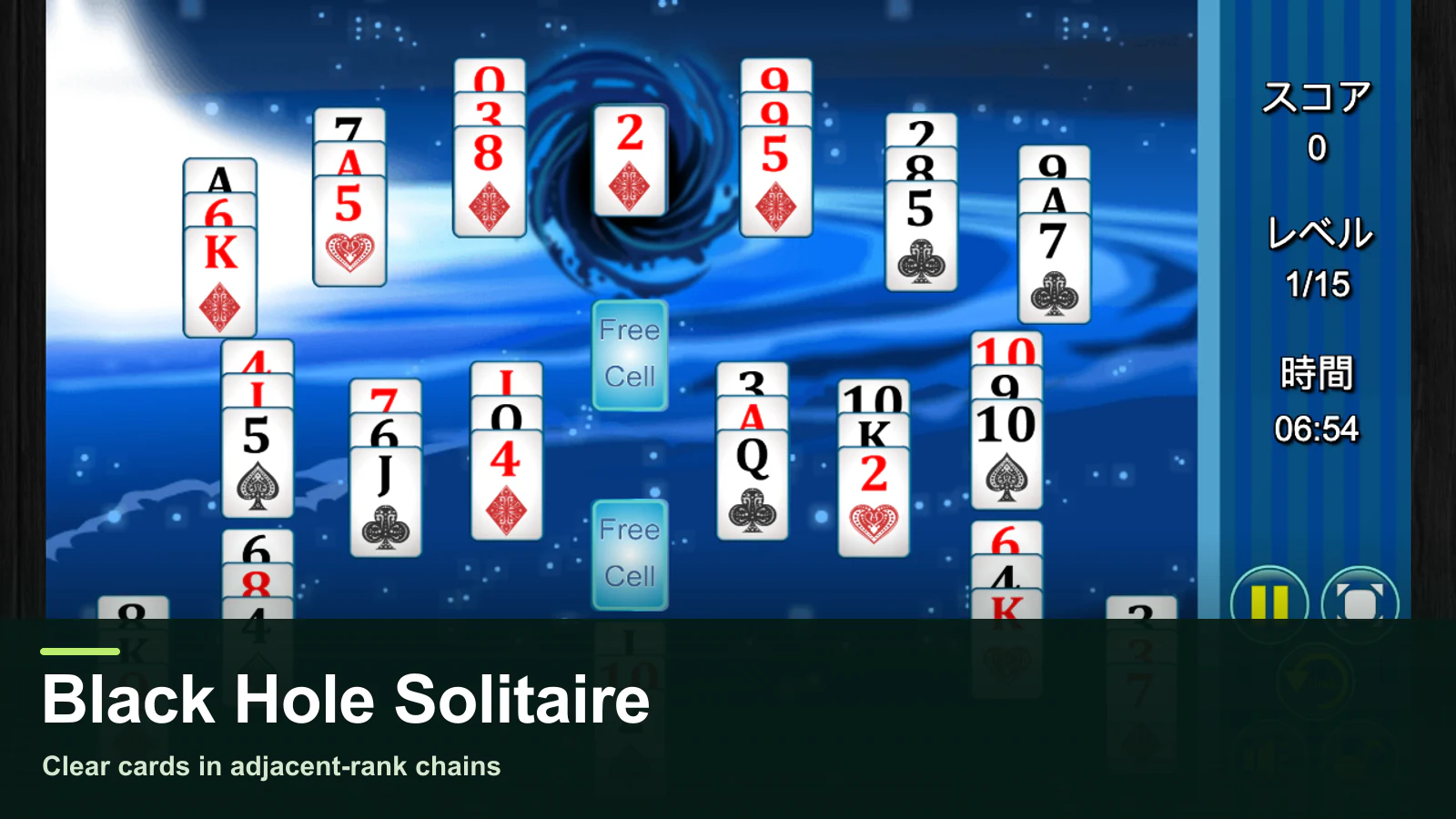
- Select a card one rank above or below the center card.
- The selected card becomes the new center for the next move.
- Use any displayed temporary slot or Undo control to test a new chain.
Controls
Black Hole Solitaire clears a layout by placing a card one rank above or below the current center card. Suits and colors do not matter. A 9 can take an 8 or 10; the card you choose becomes the new center and defines the next move. The simple rule creates a chain-planning puzzle where the first legal card is often not the best card.
When two cards fit the center, compare the next rank each choice creates. If the center is 9, playing 8 is stronger when it exposes a 7 or 9 afterward; playing 10 is stronger when it leads to J or 9. Looking two moves ahead prevents a short, attractive chain from consuming the only bridge to the rest of the layout.
In layouts with overlapping cards, removing a card can reveal new ranks. A move that only extends a chain by one may still be superior if it opens two new candidates. Do not clear isolated cards just because they fit if a covered stack is the actual source of future options.
If the edition offers temporary holding spaces, use them as bridges between chain segments. Store a rank that can restart a useful sequence after the center changes, rather than a card with no return route. If Undo is available, use it to compare two branches at the point where a chain first stopped, not only after the board is completely blocked.
Many adjacent-rank solitaire games allow Ace and King to connect, making them a useful loop in a long chain. That behavior is edition-specific. Test the visible board rule before relying on it, then avoid spending an Ace or King too early if it can later bridge two sections.
Golf Solitaire and TriPeaks also use adjacent ranks, but Black Hole centers the decision on a persistent middle card and its board structure. The best play balances chain length with the cards it exposes.
When the center is 10 and both 9 and Jack are available, make the choice by looking at the board that follows, not the card in front of you. If 9 exposes an 8 and then a 7, it creates a useful descending route. If Jack exposes a Queen but no follow-up rank, it may be the shorter branch even though both first moves are legal. This small two-step comparison is the most reliable habit in Black Hole Solitaire.
There is another reason to avoid clearing every available card immediately: a rank can be a bridge. Keeping a 9 visible may let you return from 8 to 10 after another part of the layout opens. If the edition includes a temporary slot, store a bridge card only when you can name the center rank that will bring it back into play. A stored card without a return route is usually just a delayed dead end.
Black Hole Solitaire works well when you want a fast round with meaningful choices. The rules are easy to explain, but changing one early branch can reveal a different part of the layout and change the entire chain. Players who enjoy Golf or TriPeaks will recognize the adjacent-rank idea, while the persistent center card gives Black Hole a more focused chain-planning identity.
No. Only the rank relative to the center card matters.
Prefer the one that creates another playable rank or exposes a covered part of the layout.
Loading comments...