Controls
- Build tableau cards down in alternating colors.
- Build foundations in suit from the dealt starting rank and wrap after King.
- Use the reserve top and stock cards to open the layout.
Controls
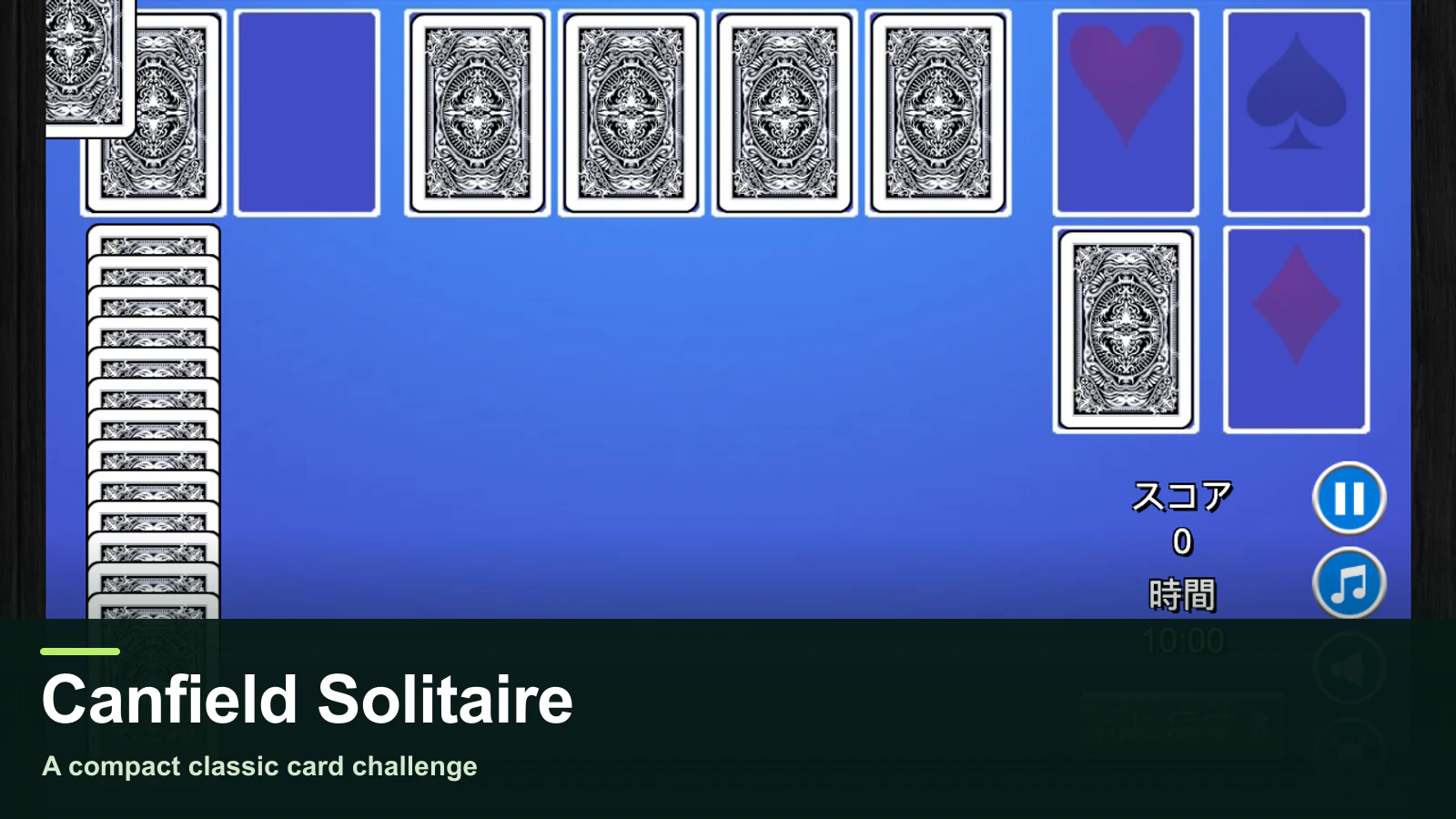
Canfield Solitaire is a compact game with a foundation rule that changes every deal. A dealt starting rank becomes the base for all four foundations. If the base is 7, each suit builds 7, 8, 9 through King, then wraps to Ace and continues to 6. The foundation is therefore a cycle, not a fixed Ace-to-King ladder.
The starting rank tells you what every foundation needs next. An Ace or King is not automatically useful; it matters only if it follows the visible foundation card. This is the key habit that separates Canfield decisions from Klondike decisions.
The tableau is short, while the reserve pile exposes only its top card. A move that frees the reserve top can matter more than an attractive foundation move. Before using the stock, check whether a tableau transfer can expose the next reserve card or create a red-black destination for it.
Empty-column rules differ by edition, so follow the live board. Whatever the rule, make the space serve a purpose: free the reserve, move a useful red-black sequence, or receive a card expected from the stock. An empty column with no planned use can remove a valuable temporary receiver.
When a foundation reaches King, the next card may be Ace. Do not treat the King as the end of that suit. Check the current top card of each foundation and think in terms of the next rank in the cycle. This prevents you from overlooking a legal foundation move or moving a needed tableau receiver too early.
Klondike foundations always begin with Aces. Canfield starts from a changing rank, uses a reserve pile, and often creates faster tactical choices. The correct move is the one that respects the current cycle while keeping the reserve accessible.
With a foundation base of 7, an 8 is immediately useful, while an Ace may need to wait until the foundation reaches King. This changes the value of cards in the reserve. Do not move a reserve 8 automatically if that move removes the only alternating-color receiver for a 7 in the tableau. Canfield rewards players who ask what rank the foundation needs next, not what rank usually starts a solitaire foundation.
The reserve gives the game a useful tension. Clearing its top card is often good, but only when the newly exposed card has a possible route. A reserve move that exposes an unusable King can be less valuable than a tableau move that creates a future destination for it. Check the next two reserve cards whenever you can see them through the current plan.
Canfield suits players who like compact boards with frequent tactical choices. A Klondike player will recognize the alternating-color tableau, but the changing foundation cycle and reserve pile make it less about opening seven deep columns and more about timing. It is a satisfying option when you want a shorter puzzle where every visible rank can change the plan.
No. It is dealt at the beginning and remains the basis for that game.
In the common cyclic ruleset, yes. Check the foundation display in the active game for the final authority.
Loading comments...