How to play
- Tap or drag a card onto the next higher rank of the same suit.
- Use the eight free cells to hold one card each.
- Build foundations upward in suit from Ace to King.
How to play
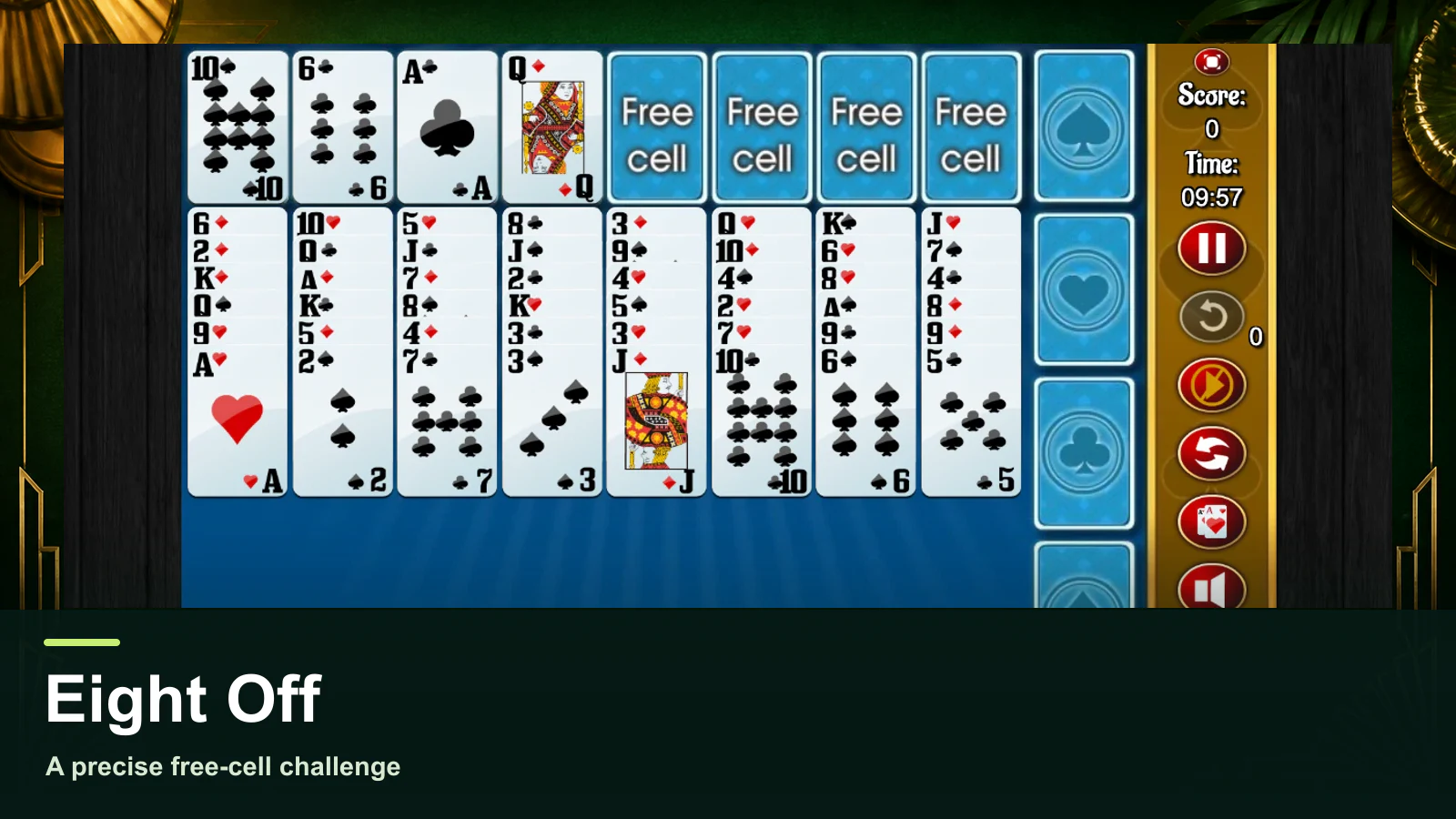
Eight Off Solitaire combines eight free cells with a strict tableau rule: cards build down in the same suit. That makes it related to FreeCell, yet very different in feel. You can see the cards from the start, but a red 8 cannot simply accept a black 7. To untangle the layout, you must create genuine suited routes while protecting enough free cells for the next transfer.
Build four foundations upward in suit from Ace to King. In the tableau, a card can move onto the next higher rank only when both cards share a suit. Each free cell stores one card. Some editions do not permit cards in an empty tableau column, so the cells—not open columns—are your main working capacity. Find the Aces and 2s early, but do not make a foundation move without checking what it changes in the tableau.
A free cell is most valuable before a complicated move, not after it. Imagine you need to free a club 7 so it can receive a club 6. Count how many blockers must be parked before that can happen. If all eight cells are already full, a seemingly simple suited connection may be impossible. Leaving one or two cells available gives you room to respond when a low foundation card becomes accessible.
Do not treat the cells as permanent storage. Before you park a card, decide what will remove it again. A temporary move has a clear return: it exposes a card, joins a suited segment, or releases a foundation rank.
A 9-8-7 suited sequence looks impressive, but it matters only if it helps move a card that is currently blocked. Short links often do more work. Moving an off-suit card into a cell so that a spade 8 can sit on a spade 9 may create a group you can relocate together later. Ask which connection opens access to an Ace, a 2, or a card hiding one of them.
Not automatically. A foundation-ready 5 might still be the only tableau receiver for a 4 that blocks another column. Send it up when doing so exposes a card, reduces a cell burden, or clearly advances a suit. Otherwise, keep the receiver while you build the route around it. The strongest Eight Off play is less about fast foundation totals and more about preserving useful destinations.
Choose Eight Off if you like fully visible layouts and deliberate, reversible planning. It rewards the same kind of capacity counting that makes FreeCell satisfying, but adds the extra puzzle of suit-specific sequences. Players who enjoy Penguin Solitaire will also recognize the value of using a cell to unlock a clean suited move.
Suppose a heart 5 is blocking a heart 4, while the only heart 6 is currently supporting another column. Moving the 6 to a foundation may look like progress, but it leaves the 5 with nowhere to go. A better sequence may be to use one free cell for the 5, move the 4 to advance the foundation, and then return the 5 to the 6. The exact ranks change from deal to deal; the useful habit is to count receivers before spending one.
No. Tableau cards must descend in the same suit, which is the game's central constraint.
Use one when it enables a defined follow-up: exposing a card, joining a suited sequence, or releasing a foundation move.
Loading comments...