How to play
- Build tableau cards down in alternating colors.
- Select any visible reserve card when it supports your plan.
- Build foundations upward in suit from Ace to King.
How to play
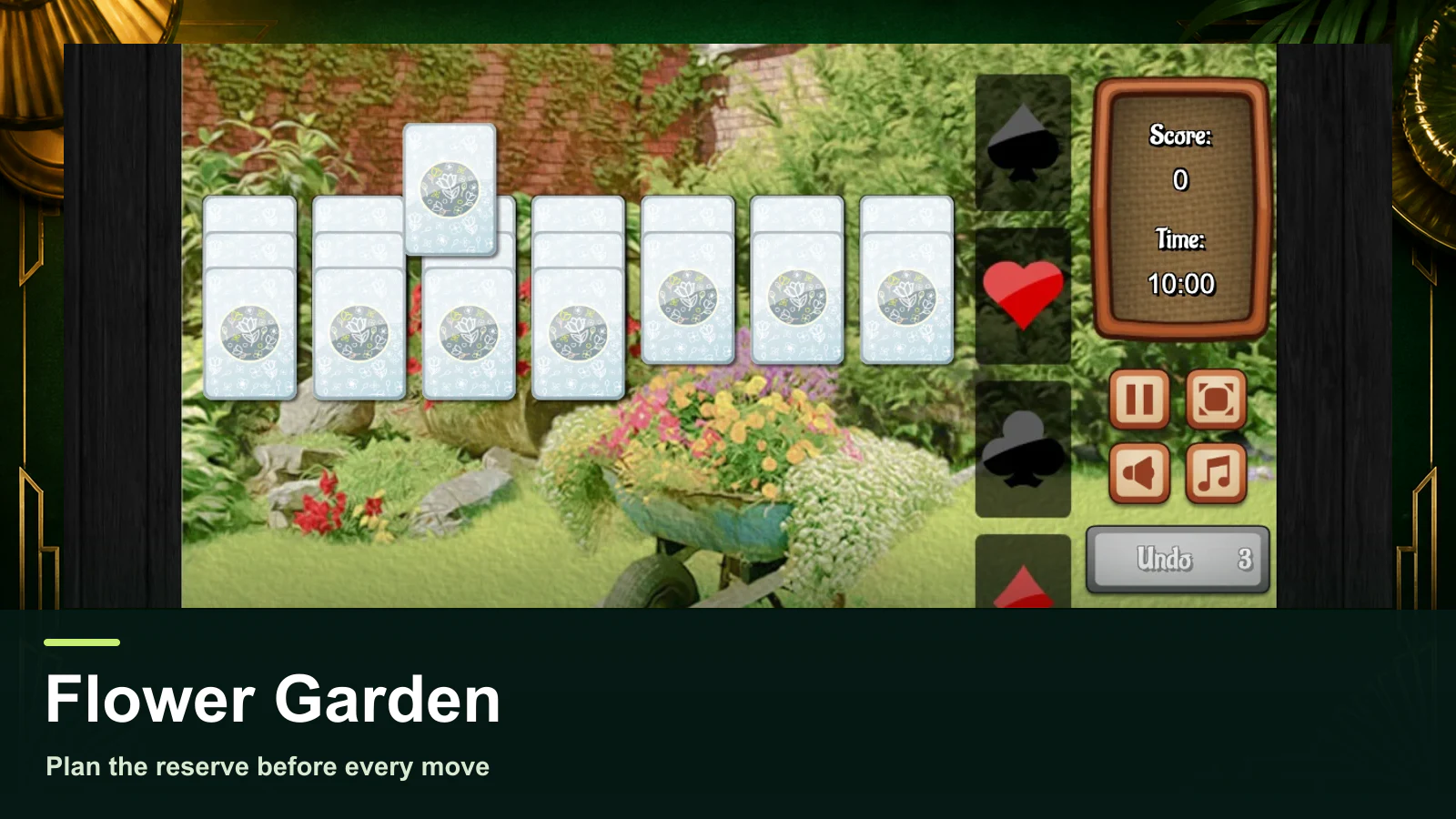
Flower Garden Solitaire gives you an unusual advantage: its reserve cards are all visible from the beginning. Sixteen cards wait above the tableau, ready to be used in any order. The tableau builds down in alternating colors and the foundations build up in suit from Ace to King. Because there are no hidden reserve surprises, the puzzle is about choosing when to use a card rather than hoping for the next draw.
Scan the reserve for Aces, 2s, and the middle ranks that can unlock tableau columns. Then look at the available opposite-color receivers in the tableau. A reserve red 7 is not immediately helpful if every black 8 is buried or needed elsewhere. Your first moves should create safe routes for the reserve, not simply send the lowest available cards to the foundations.
All tableau cards are visible, so you can compare outcomes before committing. When two moves are legal, prefer the one that exposes the card beneath a shorter or more useful column. Empty columns are valuable working space. In versions that only allow a King in an empty space, delay that King until you know the column will not be needed for a more useful transfer.
A long alternating-color stack can look productive, but it may be sitting above the exact card a foundation needs. Treat every tableau move as a way to release a target card, not as decoration for the layout.
The reserve is flexible but not free. Taking several low cards for the foundations can remove the 5s or 6s that the tableau needs as receivers. Before using a reserve card, identify its consequence: it should reveal a tableau card, complete a transfer, or make the next reserve card playable. The best reserve move often starts a two-card sequence rather than producing a single immediate foundation point.
Sending a card home is helpful when it opens a column or reduces a blocked stack. It can be harmful when it removes your only alternating-color destination. If a black 8 is holding a red 7 that will let you clear a column, keep it in the tableau until that work is done. The foundation count is progress, but the number of usable tableau routes is your real flexibility measure.
Flower Garden is a good fit when you want a calm, open-information puzzle. It has less hidden-card luck than Classic Solitaire, yet the visible reserve still creates meaningful timing choices. Players who enjoy organizing resources before making a move will appreciate its clear board and its satisfying chain reactions.
Imagine that the reserve offers a black 6 and the tableau offers a red 5 that can be moved. Playing the black 6 first may make the red 5 legal, but moving the red 5 first could reveal a black 6 already in the tableau and preserve the reserve card for later. Compare what becomes available after each order. Because the reserve remains visible, it is often stronger to save a flexible card until the tableau has shown you exactly where it belongs.
Yes. That freedom is why planning matters: choose the card that improves the tableau, not merely the first legal card.
Only if the empty space supports a planned transfer or a useful King placement. An empty space has value on its own.
Loading comments...