How to play
- Build tableau cards down in alternating colors.
- Build eight suit foundations from Ace to King.
- Use empty columns for Kings only when the placement advances a real tableau plan.
How to play
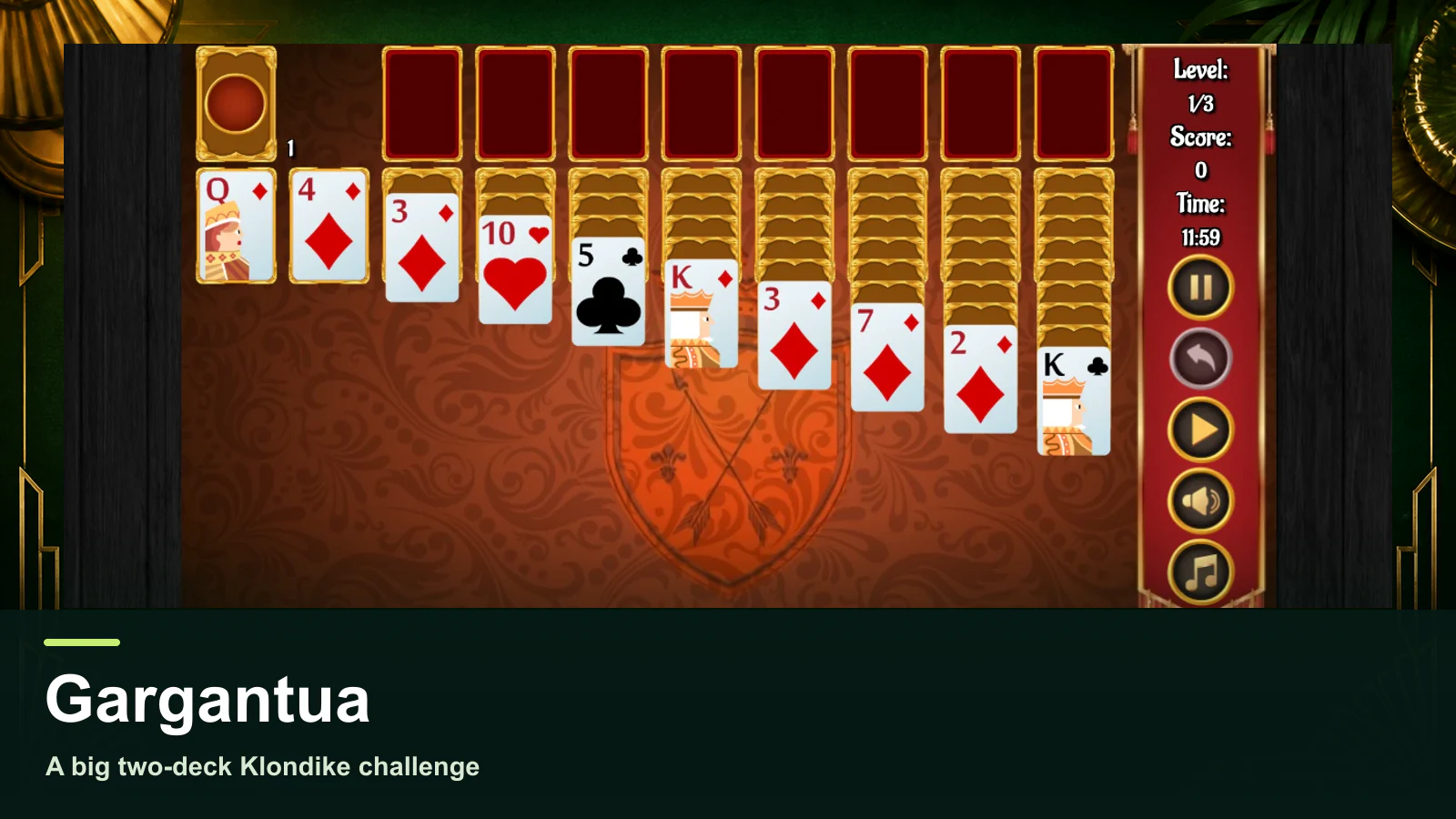
Gargantua Double Klondike expands the familiar Klondike idea into a two-deck, 104-card challenge. You manage nine tableau columns, eight foundations, and a substantial stock. Tableau cards build down in alternating colors, while each foundation builds upward in suit from Ace to King. The unusual twist is that every suit and rank appears twice, so a card can be foundation progress in one place and valuable tableau infrastructure in another.
The basic rules will feel familiar to a Klondike player, but the scale changes the priorities. There are more hidden cards to expose and twice as many foundations to track. A black 9 may have a duplicate elsewhere: one copy can go home while the other remains available to receive a red 8. That extra flexibility is useful only if you do not spend both copies before the tableau is ready.
In the opening, favor moves that turn a face-down card face up. Building a beautiful long sequence is less valuable when it leaves several columns unopened. If an empty column appears, do not automatically fill it with the first King you see. Compare the available Kings by color, by the cards they can accept next, and by the hidden card each choice may help reveal. With two decks, a better King can often appear later.
When you see two copies of a rank, assign them different jobs. One black 9 might be needed under a red 8 in the tableau; its duplicate may be safe to place on a foundation. Before moving both copies, scan for the opposite-color card one rank below. If that card is blocking a column, preserve a receiver. A foundation move is strongest when it reveals a card, creates an empty column, or makes a stock card playable.
The stock is not simply a source of new moves. First inspect the current tableau: look for a transfer that exposes a card, a low card that advances a foundation without removing a needed receiver, and an empty-column decision that has a clear purpose. When a stock card appears, ask which tableau route it supports. Rearranging the board only to fit a stock card often uses up the flexibility you need later.
Early game: expose hidden cards and stabilize Aces and 2s. Middle game: use empty columns selectively and keep duplicate ranks in complementary roles. End game: compare the next required card on all eight foundations, then work backward through the remaining tableau. Gargantua rewards patient attention more than speed, making it a natural next step after Classic Solitaire for players who want a much larger board.
If two red 8s are visible, one may be ready for a foundation while the other is the only receiver for a black 7 that covers a face-down card. Sending both 8s home reduces the visible tableau but can stop the very move that would reveal new information. Keep the receiver until the black 7 has moved, then reassess the second 8. Thinking in roles rather than in duplicate ranks is the simplest way to avoid over-clearing foundations in a large two-deck layout.
Yes. The two decks create eight foundations and two copies of every rank and suit.
No. Keep one copy in the tableau when it is still needed as an alternating-color receiver or to expose a card.
Loading comments...