How to play
- Move one exposed card onto the next higher rank of the same suit.
- Build foundations upward in suit from Ace to King.
- Use an empty pile for a King only when it supports a planned route.
How to play
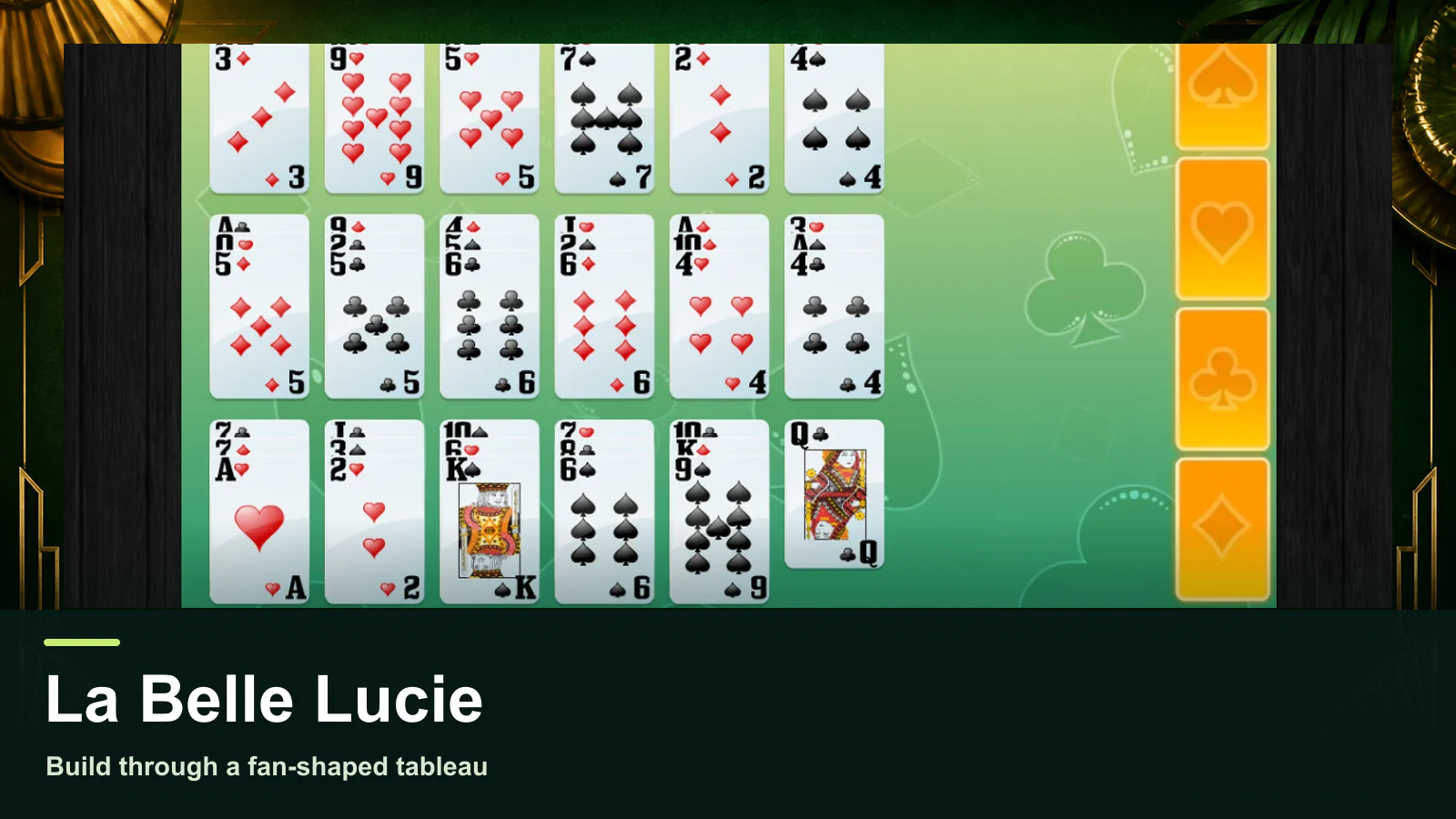
La Belle Lucie Solitaire begins with eighteen short tableau piles arranged like a fan. Only the top card of each pile is available. You build foundations upward in suit from Ace to King, while tableau cards build down in the same suit. Cards move one at a time, and empty spaces normally accept only Kings. Those constraints make each small transfer matter.
The board is open, so you can see where useful low cards are hiding. The challenge is reaching them without consuming the same-suit receivers you need later. A spade 9 may look ready for a foundation, for example, but it could be the only place a spade 8 can land while you expose a card beneath it. Progress is not merely the foundation count; it is the number of accessible routes through the fan.
Compare the short piles before moving. A card on top of a two-card pile may reveal an Ace, while the same move from a five-card pile reveals another blocker. Favor transfers that expose a foundation card, a card that can join a suited sequence, or a useful King route. Clearing a pile without knowing what it will do next can be less helpful than preserving it as a receiver.
Because alternating colors do not apply, middle cards in the same suit are valuable infrastructure. Before sending a diamond 7 to a foundation, check whether a diamond 6 needs it in the tableau. It is often correct to delay a foundation move until the 6 has moved and opened its pile. This counterintuitive patience is what separates a stable board from a board with no legal transfers.
An empty pile accepts a King, which can turn a blocked King column into a working area. But a King move should have a follow-up. Ask which suited sequence will connect after the King lands, or which low card will become exposed. If the answer is only that an empty space exists, wait. You may need the clear pile later when another King can release a more valuable route.
La Belle Lucie is for players who enjoy compact, precise puzzles. It has a smaller board than Forty Thieves, but its same-suit rule creates a similarly thoughtful pace. Every move is visible and reversible, so it is rewarding to test a sequence, use Undo if needed, and compare which order preserves more receivers.
Before moving a club 8 onto a club 9, look below both cards. If the 8 reveals a foundation-ready Ace, the transfer is immediately productive. If it only buries a club 7 that has no other destination, another pile may deserve attention first. This quick comparison keeps the fan from becoming a collection of attractive but immovable suited stacks. In a one-card-move game, the card you reveal is more important than the stack you create.
When a King is exposed, do not assume it must take the next empty pile. Look at the cards it can receive in suit order and at the low cards beneath those candidates. A delayed King move can be better when another transfer will reveal an Ace first. This small pause is often the difference between opening the fan and fixing a King in a column that cannot help.
No. Tableau transfers are one card at a time, so the order of moves is essential.
A King. Reserve the space for a King move that opens a clear next step.
Loading comments...