How to play
- Fill each gap with the next rank in the same suit as its left neighbor.
- Start rows by placing matching 2s to the right of Aces.
- Complete each suit row through King after its lower ranks are ordered.
How to play
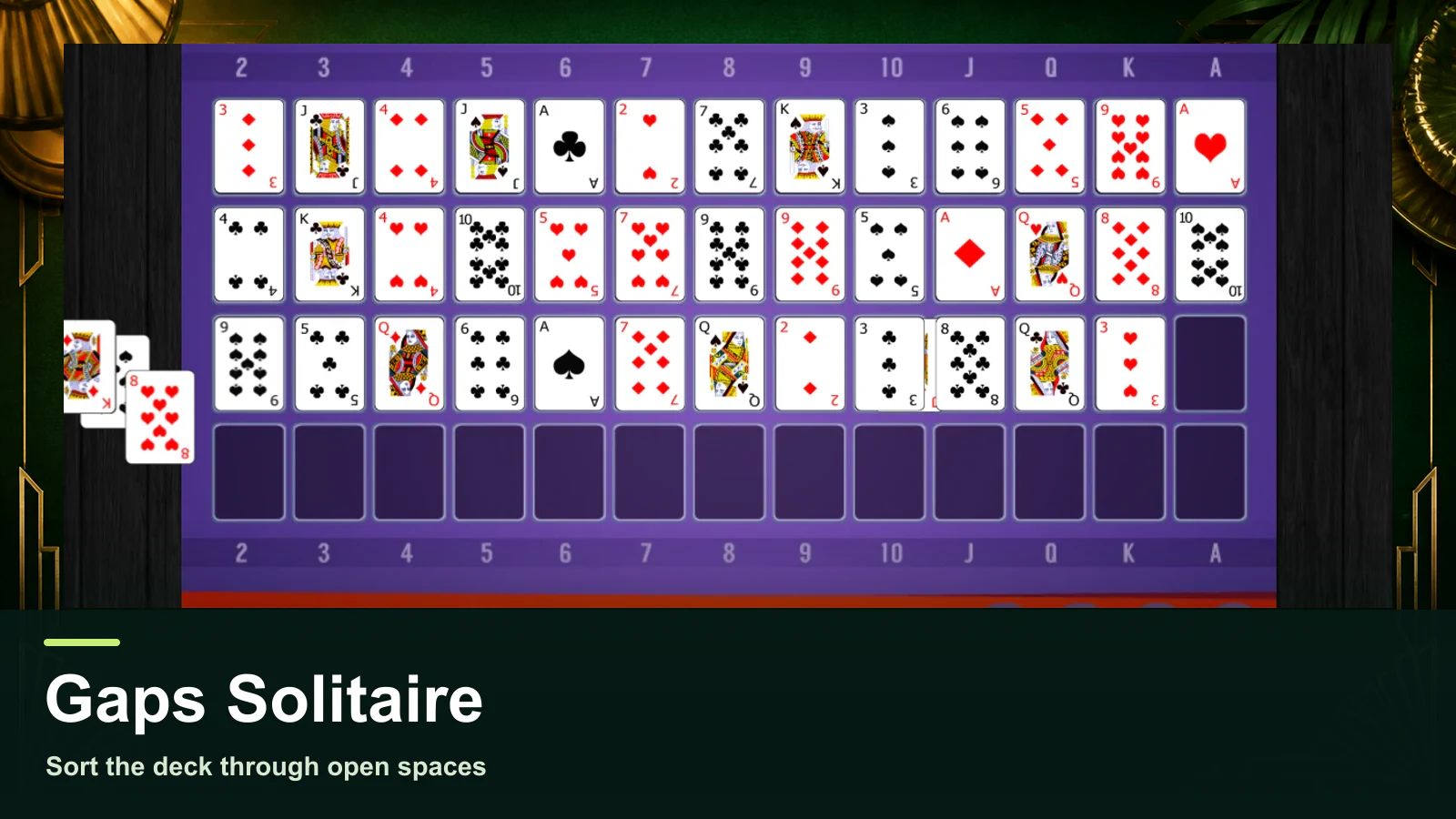
Gaps Solitaire looks different from a normal tableau game. All 52 cards sit in rows, with four empty positions moving around the layout. Your task is to arrange each row in one suit from 2 through King. Aces anchor the beginning of the rows, and the gap immediately to the right of a card tells you the only card that belongs there next.
If a club 6 sits to the left of an open position, the correct card for that gap is the club 7. When you place it, the former location of the club 7 becomes a new gap. This means every move moves the puzzle's working space. Rather than asking only where a card can go, ask what new gap it will create and whether that gap continues a useful chain.
The spaces to the right of the Aces are especially valuable because they begin a row with the matching 2. From there, 3, 4, and the later ranks can follow in order. Early play is often about creating one or two dependable sequences rather than touching every row equally. A long run from an Ace gives you a clear target at each new gap and reduces the number of loose cards competing for space.
A King closes a completed row. After a King is placed, the space to its right is no longer active, so that row can no longer provide working capacity. Do not rush a King into place just because it is legal. First make sure its row is already correct from 2 through Jack and that the other rows still offer enough open positions to finish their chains. In Gaps, a completed row is progress, but it also removes a tool.
When multiple gaps can be filled, compare the next gap each move creates. A move that creates a gap after a card whose successor is visible may start a long chain. A move that creates a gap after a card whose successor is trapped can stop immediately. This two-step check is more useful than trying to make the rows look balanced. It turns the game from random swapping into a controlled sorting puzzle.
If this version offers reshuffles, treat them as limited recovery rather than a normal turn. First read every gap: identify the card to its left and locate the exact successor required. Sometimes a short chain elsewhere will relocate a gap into the position you need. Reshuffle only after no available chain improves an incomplete row.
Gaps is ideal for players who enjoy sorting and route planning more than stacking cards. It shares the adjacent-rank rhythm of Black Hole Solitaire, but every rank also needs the right suit and final position. A quick round can still reward careful observation because one early chain changes the rest of the board.
A gap after a heart 8 needs the heart 9, but that 9 may be sitting behind an incomplete row. Filling a different gap can relocate the working space until the heart 9 becomes free. Do not judge a move only by whether it lengthens the most advanced row. A useful move is one that keeps an active chain alive or creates a gap whose successor you can reach. Reading each gap as a precise request prevents wasted reshuffles.
No. It must be the next rank in the same suit as the card immediately to the left of the gap.
It finishes a row, but that row stops providing an active gap for future rearrangement.
Loading comments...